Overview
Discover the therapeutic potential of FAHFAs, and how they are produced via microbial biotechnology.
What are Fatty Acyl Esters of Hydroxy Fatty Acids (FAHFAs)?
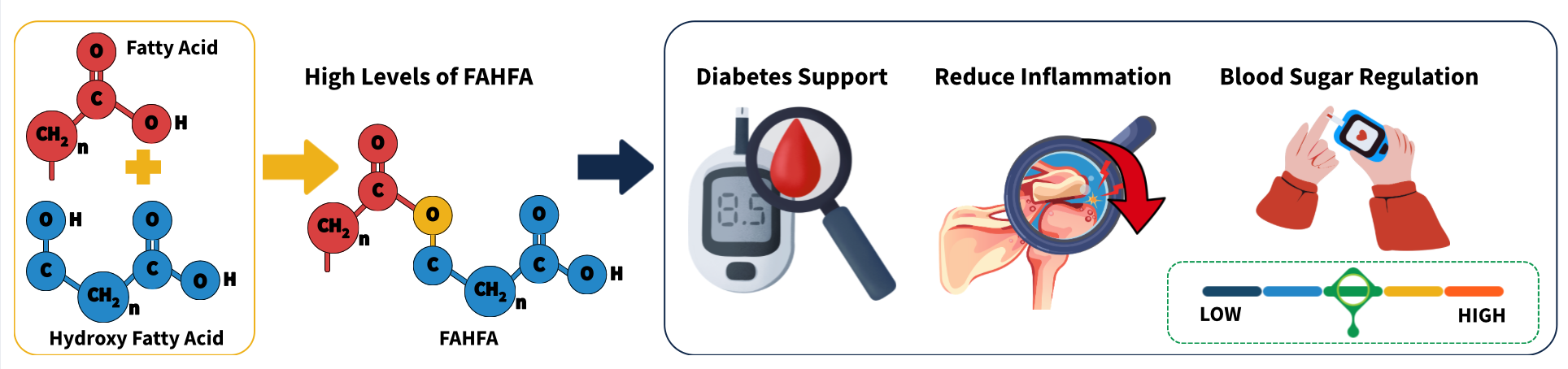
FAHFAs are a class of bioactive lipids that consist of fatty acids and hydroxy fatty acids linked via an ester bond. They were discovered in 2014 by researchers at the Salk Institute and display potential for multiple health benefits, such as reducing inflammation and enhancing insulin sensitivity, useful in the treatment of diabetes.
The scientists initially identified a strong correlation between FAHFA levels and insulin sensitivity in humans, indicating that individuals more prone to diabetes tend to have lower levels of FAHFA. Further experimentations on mice helped to establish a causal relationship, whereby diabetic mice fed with FAHFAs resulted in improved insulin sensitivity and tolerance to glucose. These research outcomes suggested that FAHFAs have the potential to help treat diabetes, reduce the inflammatory responses, and improve insulin sensitivity in humans—ideally restoring the body’s ability to regulate blood sugar levels.
With the high biological significance and distinctive physiological effects of the bioactive lipids, research has gained momentum toward detecting and quantifying FAHFA production. However, their structural complexity and low trace abundances in biological matrices present a bottleneck for efficient screening, pathway identification, and scalable production. While human bodies naturally produce FAHFAs, large-scale production is economically unfeasible, thus, targeted production is essential. In the context of PreFerS’ research premise, we focus on an alternative biosynthetic method that utilizes the oleaginous yeast Yarrowia lipolytica as a microbial cell factory for the intracellular production of FAHFAs.
The Mechanism behind FAHFA production
Y. lipolytica naturally makes and stores different fatty acids inside its cells. However, to produce FAHFA, two heterologous enzymes need to be introduced into the yeast. The first enzyme changes one of the yeast’s natural unsaturated fatty acids into a slightly different form called a hydroxy fatty acid. The second enzyme then links this hydroxy fatty acid with another fatty acid, creating FAHFA.
Once the yeast is confirmed to be producing FAHFAs, it can be grown in bioreactors, where the cells can multiply and generate FAHFAs on a much bigger scale. This approach is far more efficient and cost‑effective than trying to extract FAHFAs directly from natural sources. To boost production even further, scientists also plan to fine‑tune the media so that the yeast makes more fatty acids inside its cells, giving the enzymes more substrates to work with and increasing the overall yield of FAHFAs.